
Panda and Penguin Algorithm Updates: What They Mean for SEO in 2026

At PWD Digital Agency, we’ve helped hundreds of Australian businesses navigate Google’s algorithm updates since 2011. Two updates in particular – Panda and Penguin – fundamentally changed how SEO works. If you’re still feeling the effects of thin content penalties or dodgy backlink profiles, this guide breaks down exactly what happened, why it matters in 2026, and how to recover.

The Panda Algorithm: A Revolution in Content Quality (2011-2016)
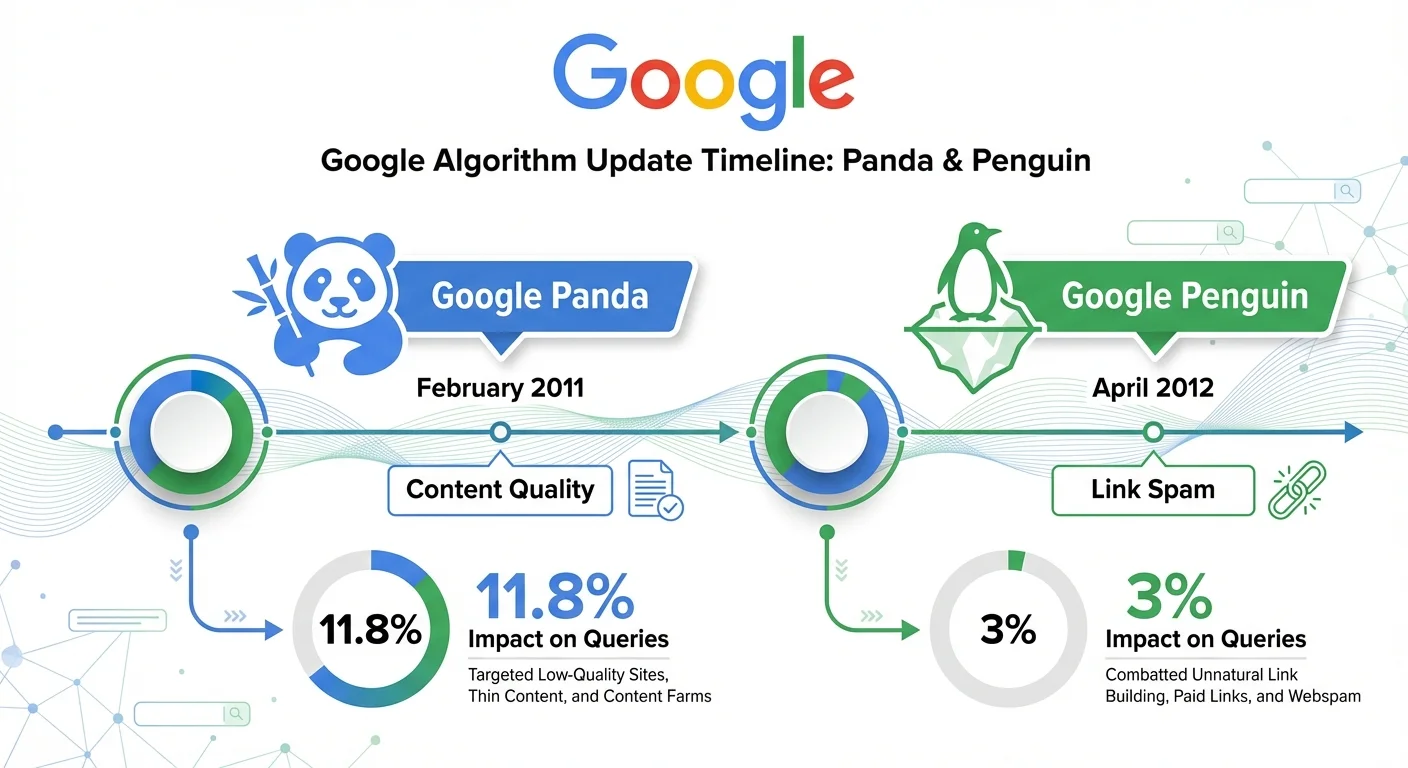
Google launched the Panda algorithm on 23 February 2011. Initially unnamed, SEOs referred to it as the “Farmer” update because it hammered content farms. It was eventually named after Google engineer Navneet Panda, who developed the core quality-scoring technology.
Purpose and Impact
Panda’s primary goal was straightforward: eliminate shallow, “thin,” or low-quality content from ranking well, and reward high-quality, original, trustworthy websites. Before Panda, content farms dominated search results by aggregating stolen or poorly written content to rank for thousands of keywords. When it first rolled out, Panda impacted a massive 11.8% of U.S. search results – one of the largest shakeups Google had ever delivered.
Panda functioned as a site-wide quality filter rather than a page-specific penalty. It heavily targeted three categories of poor content:

- Thin Content: Pages with very little text that added no value to the reader.
- Duplicate Content: Content copied from other sources, or massive amounts of internally duplicated pages (like thousands of identical product pages).
- Low-Quality Content: Pages that were poorly written, unoriginal, or created solely for search engines rather than human readers.
To help webmasters understand what Panda considered “high-quality,” Google’s Amit Singhal released a famous 23-point checklist. This list asked questions like, “Would you trust the information presented in this article?” and “Would you be comfortable giving your credit card information to this site?” – questions we still use in our content audits at PWD today.
Evolution and Core Integration
Throughout 2011 and 2012, Panda received continuous data refreshes and international expansions, eventually supporting languages worldwide. Major milestones included Panda 4.0 in May 2014, designed to be a “gentler” algorithm for some websites, and Panda 4.1 in September 2014, which aimed for higher precision.
Initially, Panda was run periodically – if a site was penalised, the owner had to fix the issues and wait for the next Panda “refresh” to recover. In January 2016, Panda was officially rolled into Google’s core ranking algorithm. From that point onward, it evaluated site quality continuously as a foundational, real-time part of how Google ranked the web.
The Penguin Algorithm: The War on Manipulative Links (2012-2016)
Following Panda’s success in cleaning up on-site content, Google introduced the Penguin algorithm on 24 April 2012. While Panda focused on content quality, Penguin specifically targeted off-site SEO factors – mainly manipulative backlink profiles.
Purpose and Impact
Before Penguin, SEOs could easily manipulate Google’s algorithm by generating thousands of unnatural, low-quality backlinks from link farms, self-made articles, blog comments, or spammy directories. They heavily relied on exact-match “anchor text” to force pages to rank for specific commercial keywords.

Penguin was designed to decrease rankings for sites utilising these webspam tactics. It acted as a site-wide “trust factor” reduction. When it first launched, it impacted roughly 3% of search queries – smaller than Panda, but devastating for sites that had relied on link manipulation.
Recovery and the Disavow Tool
Recovering from a Penguin hit was notoriously difficult. Like early Panda, Penguin was a periodic filter. Webmasters who were penalised had to conduct extensive link audits, manually remove as many spammy links as possible, and use Google’s Disavow Tool to ask Google to ignore the remaining bad links.
Even after cleaning up a backlink profile, a site would not recover until Google ran the next Penguin update – which sometimes took many months, or even over a year, to occur. We saw this firsthand with several clients at PWD who had inherited toxic backlink profiles from previous agencies. The recovery process required patience, persistence, and a methodical approach to link cleanup.

Evolution and Core Integration (Penguin 4.0)
Penguin saw several iterations, including Penguin 2.0 in 2013 and Penguin 3.0 in 2014. The final and most significant change occurred on 23 September 2016, with the release of Penguin 4.0. With this update, Penguin – like Panda before it – was fully integrated into Google’s core search algorithm.
This integration brought two massive changes:
- Real-Time Processing: Webmasters no longer had to wait months for a manual data refresh. As soon as Google crawled a site and processed disavowed or removed links, recovery could happen in real-time.
- Granularity: Instead of levying massive, site-wide penalties, Penguin 4.0 became more granular, devaluing spam by adjusting rankings for individual pages or links.
Legacy: From Panda and Penguin to the Modern SEO Landscape
Looking back from 2026, Panda and Penguin were the one-two punch that ended the “Wild West” era of SEO. Before them, manipulative keyword stuffing, content farming, and aggressive link-buying were standard industry practices.

By rolling both Panda and Penguin into the core algorithm in 2016, Google established the modern baseline for search quality. These early algorithms laid the technical and philosophical groundwork for Google’s highly advanced AI systems of the 2020s.
The principles established by Panda – focusing on user-centric, expert, and trustworthy content – directly evolved into the massive Helpful Content Updates of 2022 and 2023, which targeted content created primarily to game search rankings rather than help humans. Similarly, Penguin’s war on link spam evolved into Google’s AI-driven SpamBrain link spam updates of 2021 and 2022, and the extensive Spam Updates of 2024 and 2025, which autonomously neutralise unnatural links and scaled content abuse.
Today, the foundational rules enforced by Panda and Penguin remain the absolute bedrock of search engine optimisation. If you want to rank in 2026 and beyond, the formula hasn’t changed: create genuinely helpful content for your audience, and earn quality links through legitimate means. That’s the approach we take at PWD for every client campaign.
How to Check if You’ve Been Hit by Panda or Penguin
If you’re unsure whether your site has been affected by these algorithm updates, here’s a practical checklist we use at PWD:
- Check your traffic timeline: Map sudden drops in organic traffic against known algorithm update dates. Google Search Console is your best friend here.
- Audit your content quality: Run through Google’s 23-point checklist. Be honest – would an expert in your field put their name on your content?
- Review your backlink profile: Use tools like Ahrefs or SEMrush to identify spammy, irrelevant, or paid links pointing to your site.
- Check Google Search Console for manual actions: Navigate to Security & Manual Actions to see if Google has flagged your site directly.
- Analyse your thin content: Identify pages with under 300 words, duplicate title tags, or content that adds no unique value.
Recovery Strategies That Actually Work
Based on our experience recovering dozens of penalised sites across Australia, here are the strategies that deliver results:
For Panda-Related Issues
- Remove or consolidate thin pages: Merge low-value pages, noindex them, or rewrite them with substantial, expert content.
- Eliminate duplicate content: Use canonical tags, 301 redirects, or rewrite duplicate pages to be genuinely unique.
- Invest in E-E-A-T: Add author bios, cite credible sources, and demonstrate real-world experience and expertise in your content.
For Penguin-Related Issues
- Conduct a full backlink audit: Export your link profile and categorise each link as natural, suspicious, or toxic.
- Request link removals: Contact webmasters to remove spammy links before resorting to the Disavow Tool.
- Submit a disavow file: For links you can’t get removed, submit a disavow file through Google Search Console.
- Build quality links going forward: Focus on earning editorial links through great content, digital PR, and genuine industry relationships.
Frequently Asked Questions
What is the Google Panda algorithm update?
Google Panda was a search algorithm update launched in February 2011 that targeted low-quality, thin, and duplicate content. It functioned as a site-wide quality filter and was integrated into Google’s core algorithm in January 2016. Panda’s principles directly evolved into the Helpful Content Updates of 2022-2023.
What is the Google Penguin algorithm update?
Google Penguin was launched in April 2012 to combat manipulative link building practices, including link farms, paid links, and exact-match anchor text spam. Penguin 4.0 (September 2016) was integrated into the core algorithm with real-time processing and page-level granularity.
How do I recover from a Google Panda or Penguin penalty?
For Panda recovery, audit your content quality, remove or improve thin pages, and eliminate duplicate content. For Penguin recovery, conduct a backlink audit, remove toxic links, submit a disavow file through Google Search Console, and focus on building legitimate, high-quality backlinks going forward.
Are Panda and Penguin still relevant in 2026?
Yes. While Panda and Penguin were integrated into Google’s core algorithm in 2016 and no longer receive named updates, their principles remain foundational. Panda evolved into the Helpful Content System, while Penguin’s anti-spam capabilities evolved into SpamBrain and the ongoing Spam Updates of 2024-2025.
What is Google’s Disavow Tool and when should I use it?
Google’s Disavow Tool allows you to tell Google to ignore specific backlinks when calculating your site’s rankings. Use it as a last resort after attempting manual link removal – particularly for toxic links from link farms, paid link networks, or spammy directories that you cannot get removed by the webmaster.