The 6-step guide to building a digital marketing funnel that fits your business

To create a digital marketing funnel, map the six steps a customer takes from first seeing your business to buying again (exposure, discovery, consideration, conversion, relationship, retention), then put one channel, one asset and one measure against each step. Most funnels fail because they are copied from a generic model rather than built from how your customers actually buy. This guide covers the six steps, how to build a custom funnel that fits your business, and a worked example for a Perth service business.
What is a digital marketing funnel?
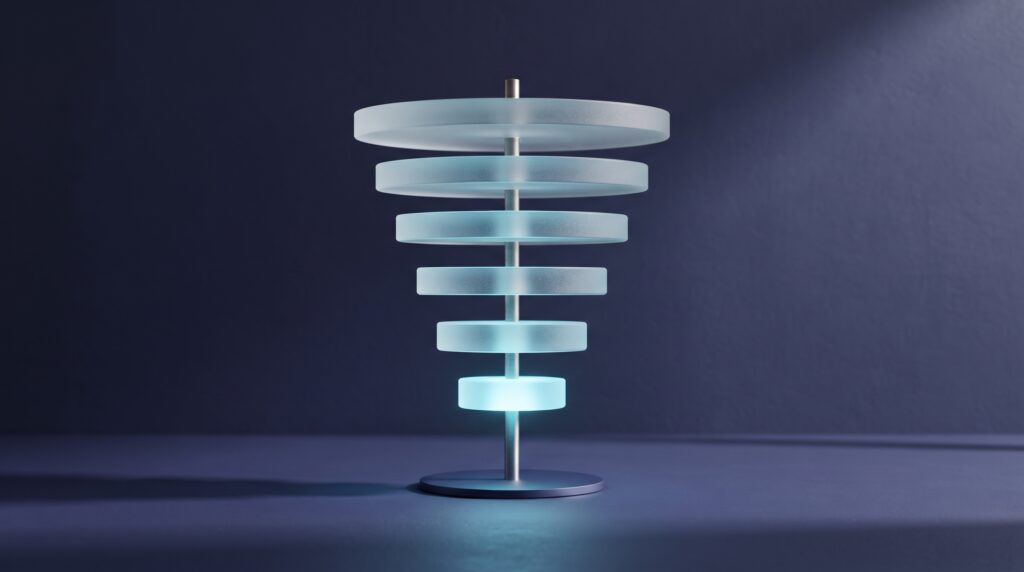
A digital marketing funnel is the sequence of stages a person moves through online from first hearing of you to becoming a repeat customer, with fewer people at each stage than the one before.
The funnel has three sections. The top is about being seen and getting the right people to your website. The middle is about turning visitors into leads and leads into customers. The bottom is about keeping those customers and getting more work from them. For more depth, see what is a marketing funnel.
The six steps below sit inside those three sections, two in each.
How to build a digital marketing funnel in six steps
1. Exposure (top)
Exposure is where a potential customer first sees your business, and for most Australian businesses that means Google. Someone searches for the service or product, and you are either there or you are not.
Two channels do this job. Google Ads puts you at the top of the results for the searches you choose from the day the campaign starts. SEO earns you a place in the organic results and the map pack over months, and keeps producing after the ads stop. Social advertising adds a third route for people who are not searching yet.
The asset here is the search result or ad itself, and its only job is to earn the click from the right person.
2. Discovery (top)
Discovery is what happens in the first ten seconds after the click. The visitor decides whether you do what they need, whether you serve their area, and whether you look credible enough to keep reading.
The asset is the landing page or service page. It must say what you do and where in the first screen, show proof (reviews, photos of real work, certifications), and make the next step obvious. Traffic that lands on a slow, vague or generic page leaves, and the funnel breaks here more often than anywhere else.
Give visitors who are not ready to enquire a smaller step, such as a guide or price list in exchange for an email address, so a visitor becomes a lead you can contact.
3. Consideration (middle)
Consideration is where the lead compares you with the alternatives.
The assets here answer the questions that stop people buying: what it costs, how long it takes, what could go wrong, what happens if they are not happy. Frequently asked questions, case studies with named clients, detailed reviews and comparison pages do this work. Remarketing ads keep you in front of the lead while they think.
4. Conversion (middle)
Conversion is the enquiry, booking or purchase. The job at this step is to remove friction: a form with as few fields as the job needs, a phone number that is answered, a quote that arrives when you said it would.
Send people to a page built for the action you want, not to the homepage. A dedicated landing page with one message and one call to action converts better than a general page every time. Where the product allows, a free trial, a sample or a no-obligation site visit lowers the risk of saying yes.
5. Customer relationship (bottom)
The relationship step starts the moment someone pays. The customer needs to feel that the business is still interested now the money has changed hands.
Make the next steps clear: what happens now, when, and who to contact. Give them a direct email or phone number. A short how-to guide in the first week for products, or a check-in call after the job for services, does most of this.
Every customer who feels looked after is a review, a referral and a repeat job waiting to happen.
6. Customer retention (bottom)
Retention is the deliberate work of getting the next job from an existing customer. A monthly email with something useful, a seasonal reminder, an offer only past customers get, and a request for a review at the right moment all belong here.
Interview a few happy customers for case studies. It gives you proof for the consideration step, and the conversation shows where your funnel is weak. Revisit the structure every quarter with what you learn.
What are the different types of marketing funnels?
The main types are the lead generation funnel, the e-commerce funnel, the booking funnel and the local service funnel, and the difference between them is where the conversion happens and how long consideration takes.
- Lead generation funnel: conversion is an enquiry, and a salesperson closes it later. Used by builders, professional services and business-to-business companies. Consideration can take weeks.
- E-commerce funnel: conversion is a purchase on the website. Consideration is short, and the work is in product pages, checkout and abandoned-cart follow-up.
- Booking funnel: conversion is an appointment. Used by clinics, salons and trades with online scheduling. The asset is the booking flow itself.
- Local service funnel: conversion is a phone call from the map pack or a search ad. Consideration is often minutes, so the Business Profile and an answered phone matter more than a long website.
How do I create a custom funnel that fits my business rather than using a generic model?
Build the funnel from how your customers actually buy, not from a diagram. Start with your last 20 customers and write down, for each one, how they first heard of you, what they looked at before enquiring, how long they took, what nearly stopped them, and what made them choose you. The pattern in those 20 answers is your real funnel.
Then adjust the model to fit:
- Cut steps that do not exist. An emergency plumber has no consideration step to speak of. The customer searches, calls the first business that answers, and buys. Spend on the map pack and the phone, not on nurture emails.
- Add steps that do. A commercial builder often has a tender or shortlist stage between consideration and conversion. Put an asset against it, such as a capability statement, rather than pretending it is not there.
- Name the drop-off. Look at your analytics and ads data for the stage where the numbers fall hardest. That is the step to fix first, and it is rarely the top.
- Match the length. A twelve-month buying cycle needs remarketing and email that keep you present for twelve months. A same-day purchase needs neither.
- Put one measure on each step. Impressions and clicks at the top, leads and enquiry rate in the middle, repeat purchase and review count at the bottom. One number per step, checked monthly.
A custom funnel is the generic one with the steps your customers skip removed and the ones they take added. Write it on one page with the channel, the asset and the measure for each step.
A service business example: a shower repair company in Perth
Take a shower repair company. Customers find them when a shower leaks, so the funnel is short and search-led.
Exposure: Google Ads on “shower repairs Perth” and “leaking shower” searches, plus a Google Business Profile ranking in the map pack for nearby suburbs and organic rankings for the repair pages.
Discovery: a landing page that says shower repairs, the suburbs covered, and a phone number in the first screen, with photos of real jobs and reviews beneath.
Consideration: a short FAQ on cost, how long a repair takes and the warranty, and a page comparing repair with full replacement. Remarketing to visitors who did not call.
Conversion: a call or a quote form with four fields. Calls tracked so the business knows which search produced them.
Relationship: a text the day after the job checking everything is dry, with a review link.
Retention: an annual email reminder about resealing and a referral offer.
This is the shape of PWD’s work for AllSealed Shower Repairs, which our lead generation page reports at 235+ leads a month at $35.82 cost per lead. The funnel is built from how a person with a leaking shower behaves, and every step has a measure. More client results are on our work.
Which type of goal allows you to specify a funnel?
In the old Universal Analytics, the Destination goal type was the one that let you define a funnel of pages leading to the goal. Google Analytics 4 replaced goals with key events, and funnels are now built separately in the Explore section as a funnel exploration, where you define each step as a page view or event and see where users drop off. Build the exploration around the steps above and make sure enquiry, call and purchase events are recorded before you trust the numbers.
When to hand this to an agency
Hand the funnel to an agency when you can describe the steps but cannot build the assets (landing pages, tracking, ad campaigns, email automation), when you have traffic at the top and no enquiries at the bottom and cannot see where they are leaking, or when the funnel spans three or more channels that nobody in the business has time to run together. A good agency builds the funnel from your customer data, sets up tracking before spending, and reports on leads and cost per lead at each step.
Keep it in-house when the funnel is short, local and phone-led, and one person can own the Business Profile and answer the phone.
Build a lead generation funnel with PWD
PWD builds and runs lead generation funnels for Perth businesses from our West Leederville office, with Google Ads, SEO, social advertising, landing pages, call tracking and email all delivered in-house. We start with how your customers actually buy, put a measure on every step, and report on leads and cost per lead.
Talk to PWD about lead generation marketing, or call 08 6146 0195 to book a strategy call.